Choosing peace in a divided world
‘Hatred stirs up conflict, but love covers over all wrongs.’ Proverbs 10:12
Peter Waddup, CEO The Leprosy Mission
As we approach the UN’s International Day of Living Together in Peace on 16 May, I’ve been reflecting on what it truly means to choose peace in a divided world.
We do not have to look far to see that we are living in a divided nation. The headlines tell their own story. Hate crime has reached record levels across the UK, revealing deep fractures running through our communities. Heartbreakingly, many people are forced to live smaller lives through fear of violence.
Last month’s abhorrent terrorist attack in North London was a stark and painful reminder of this reality. Jewish communities continue to be disproportionately targeted by these shameful acts. At the same time, nearly half of all religious hate crimes last year were directed at Muslim communities. Last week’s election results have only served to underline the depth of unrest and division across the country.
As Christians, it is deeply troubling to witness people being persecuted for their faith and beliefs. Christ tells us to expect trouble for following Him, and yet He still calls us to be peacemakers.
If I’m honest, it’s easy to dwell on what grieves us and be drawn into a spiral of negativity. Bitterness can feel like the easier path for the human heart. It is often simpler to withdraw, to mistrust those who are different from us, whether in race, religion or background, than to reach out in love.
And yet, have you noticed how often it takes a difficult moment, perhaps a crisis in our own family or community, to refocus us on what is good and right? The illness of a loved one, or the pursuit of justice for someone in need, can draw people together in unexpected ways. We saw this during the pandemic, when neighbourly love quietly flourished in a time of adversity.
I have seen this same pattern in some of Sri Lanka’s poorest communities. Divided people coming together for the greater good, united by a shared desire to overcome the injustice of a cruel disease that does not discriminate by religion or ethnic group.
Our interfaith work in Sri Lanka began in 2014, with churches raising awareness about leprosy. But it didn’t stop there. Leaders from different faiths soon joined together, united by a shared desire to support those affected by this devastating disease. What began as a health initiative became so much more.
After the 2019 Easter Sunday attacks, when the country was grieving and deeply divided, these same faith leaders remained united. Together, they continued their work, building bridges and offering hope and practical support.
In their communities, Leprosy People Associations were formed. These brought together people of different faiths and ethnic backgrounds, united by their shared experience of the disease. Together, they problem solve challenges such as food shortages and recovery from climate-related disasters, sharing knowledge and resources.
Many still carry deep wounds in their hearts. Yet they choose to come together.
In one association in the northern province of Jaffna, 96 of the members are Tamil and just two are Sinhalese. Yet when it came time to elect two leaders, one of those chosen was Sinhalese. This was not a symbolic gesture, but simply because he was the person the community trusted and wanted.
It is hard for us to fully grasp the depth of the wounds many of these individuals carry. While the naturally beautiful island of Sri Lanka has attracted visitors for centuries, it is still healing from a 26-year bloody civil war rooted in ethnic tensions between Sinhalese and Tamil communities. And yet, bound by a shared commitment to overcoming the suffering caused by leprosy, these groups have found something stronger than division.
I remember meeting Mr Amarasingha, who went on to lead the Leprosy People Association across Sri Lanka. A Sinhalese Buddhist, he was once rescued and cared for by Rev Joshua, a Tamil man from a community he had previously despised, when he was diagnosed with leprosy in 2015. Today, Mr Amarasingha gives what little he can to support children from that same Tamil community.
It’s incredible really, and shows not only God’s healing power in a divided world, but that we have a choice. We can allow fear and suspicion to shape us. Or we can choose love.
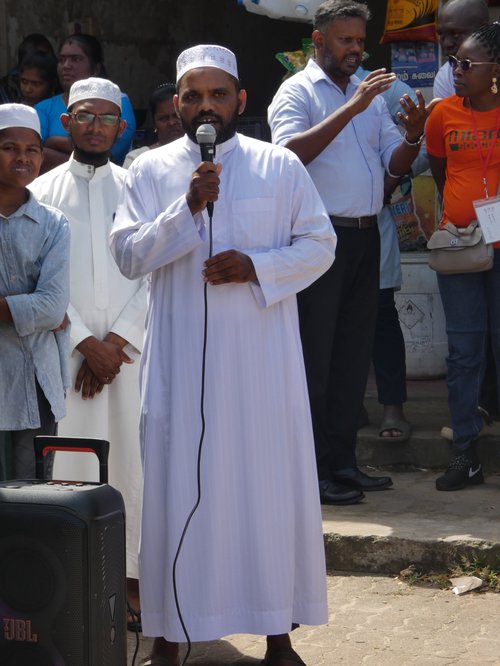
Iman Atham Lebbe Mohamed Rifkan, in northern Sri Lanka, was one of 60 faith leaders trained in leprosy awareness and screening in 2025. He is pictured addressing a crowd after a street drama that shared a simple but powerful message: Leprosy is a disease like any other, it can be cured and there is nothing to fear.